
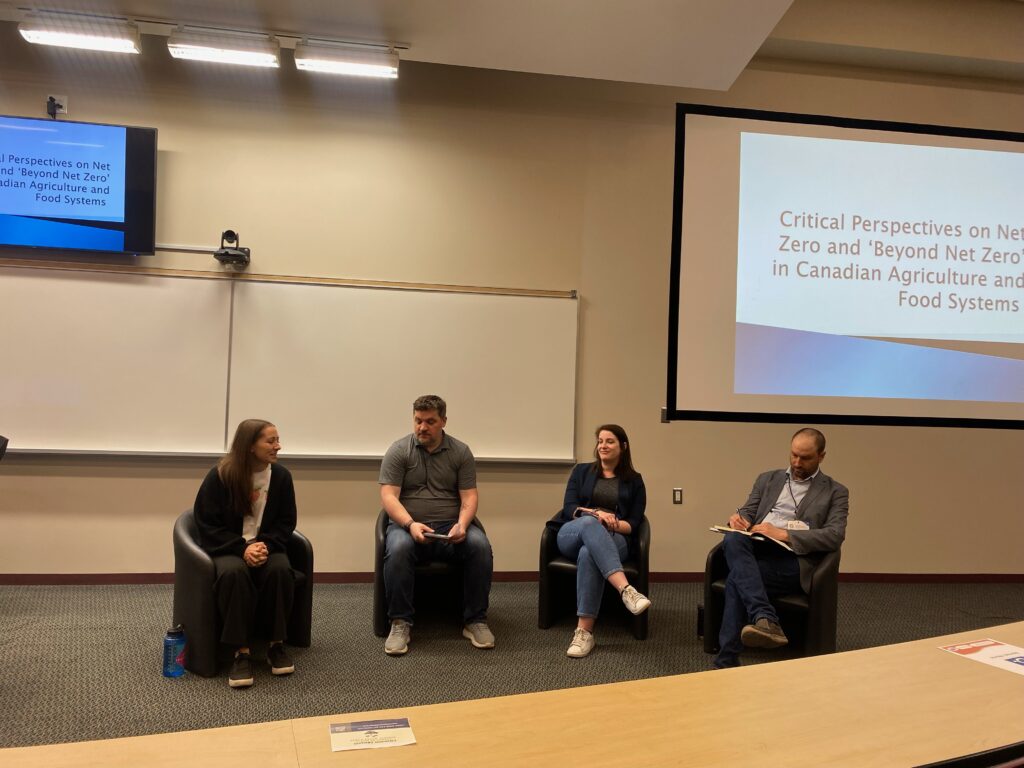
Common Ground Network members gathered at CAFS for a roundtable panel to discuss “Critical perspectives on net zero and beyond net zero inCanadian agriculture and food systems”. Emily Duncan (University of Regina), Ryan Katz-Rosene (University of Ottawa), and Andrew Spring (Wilfred Laurier University) covered 1) the concept of net zero and its limitations for “agriculture”, and 2) a lack of implementation of tools and general paucity of data for accurate net zero measurement in agriculture.
Debora Van Nijnatten was absent the day of the panel, but she shared slides that Dr. Spring presented to set the stage in defining net zero as simultaneously a scientific concept (i.e., working within planetary temperature limits or a CO2 and equivalent budget), a political target (e.g., net zero by 2050 to limit temperature rise), and a policy approach (i.e., emissions reductions plan to achieve targets). Dr. Katz-Rosene followed and explored Canada’s specific CO2 emissions targets, while critiquing the fact that there is often a focus on CO2 alone, and an omission of a focus on greenhouse gases that have a more significant impact (e.g., methane), leading to a lack of understanding of the agri-food sector’s overall emissions profile.
Furthermore, the lack of focus on other environmental indicators creates damage beyond climate specific reductions targets. Thus, panelists raised the limitations of net zero approaches, emphasized that long-term planning is needed to achieve targets, and encouraged us to look beyond the narrow climate policy vision for social, economic and environmental sustainability. Dr. Duncan followed by discussing the limited technology, and limited uptake of technologies by farmers, to measure the amount of carbon that is being sequestered in soil. Furthermore, she discussed the need to bring farmers on board with policies and programs that may benefit them (e.g., carbon credits), especially when they are playing a role in mitigation. Finally, Dr. Spring discussed that in some cases net zero carbon policies foragriculture don’t exist yet, such as in the Northwest Territories, so there is an opportunity to start fresh. However, there may be a need to questionwhether “net zero” is the proper framing, or whether a broader sustainability approach including environmental protection would be more beneficial.